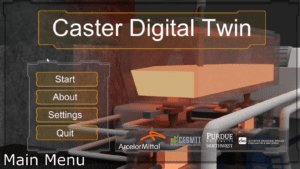
 On March 25, CIVS Director Chenn Zhou and Research Engineer Sam Nielson presented simulation research at ArcelorMittal CFD and Thermomechanics Days, the 9th edition of this biennial event. Their presentations highlighted how computer simulation, visualization, and artificial intelligence are driving smart steel manufacturing, enabling tools such as digital twins for real-time decision-making and improved efficiency, productivity, and sustainability. They also showcased cutting-edge modeling approaches applied to key steelmaking processes, including blast furnaces, electric arc furnaces, and direct reduced iron (DRI) systems, with a focus on decarbonization strategies and operational optimization through advanced computational fluid dynamics.
Dr. Zhou presented the Keynote “Smart Steel Manufacturing through Simulation: latest advancements”. Computer simulation, visualization, and Artificial Intelligence (AI) are becoming central to smart manufacturing. Together, these technologies enable cutting-edge physics-based and data-driven tools, such as digital twins, for real-time decision-making, helping to address critical challenges related to energy efficiency, productivity, quality, operational performance, maintenance, and more. These state-of-the-art tools provide both fundamental insights and practical guidance for process design, troubleshooting, optimization, new process development and scale-up, as well as workforce development. Through partnerships with ArcelorMittal and other member companies of the Steel Manufacturing Simulation and Visualization Consortium (SMSVC), significant advancements have been achieved in smart steel manufacturing through simulation. This talk will highlight the state-of-the-art models and methodologies developed and applied to simulate blast furnaces, electric arc furnaces (EAF), reheating furnaces, and other steelmaking processes.
Sam presented “Numerical Simulation of Reducing Gas Composition Impacts on DRI Shaft Furnace Operation”. As the steel industry investigates processes for decarbonizing virgin iron production, the Direct Reduced Iron (DRI) process stands out as one of the most well-established processes with a path to reach zero CO2 emissions. Several researchers and industrial operators have begun exploring the concept of carbon-free DRI, which presents unique operational challenges. This paper discusses the development of a new Computational Fluid Dynamics (CFD) model of the DRI furnace using a Eulerian multiphase approach to handle the burden and gas flow, and the application of this model to investigate high and low productivity operations, as well as a test scenario for 100% H2 DRI operation. Typical industrial operating conditions are used for validation of the CFD modeling approach, with existing comparisons showing an average difference of 7% from industrial data. This study also explores how the location of reaction regions differ in the furnace with varying productivity and reducing gas composition, as well as the sensible and chemical heat energy demands for achieving target metallization with varying reducing gas compositions.
The post CIVS Staff Present Research at ArcelorMittal CFD and Thermomechanics Days appeared first on Center for Innovation through Visualization and Simulation (CIVS).