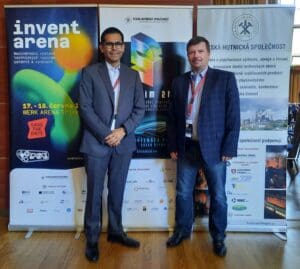
 On September 2 and 4, CIVS EAF and casting research was presented at the SteelSim International Conference in Třinec, Czech Republic.
On September 2, CIVS Research Scientist Orlando Ugarte delivered a plenary talk “Integrated CFD Models for Optimizing Scrap Melting in DC EAF”. The paper is co-authored by CIVS Ph.D. student Shiyu Wang, CIVS Associate Director for Research Ty Okosun, SSAB collaborators Sunday Abraham, Yufeng Wang, Randy Petty, and CIVS Director Chenn Zhou.
In the U.S., ~70% of steel is produced in electric arc furnaces (EAFs), and significant investment is devoted to increase EAF production capacity. EAFs integrate chemical and electrical energy to melt scrap, precipitating phase changes and reactions that need to be controlled to achieve the desired molten steel. The multi-phenomena nature of EAF operations presents challenges for optimization. This study applies an advanced CFD methodology to simulate the operation of an industrial DC-EAF to study the impact of electrical arc power on melting. Namely, a CFD tool integrating a coherent-jet model, a DC arc heating model and a scrap melting model is applied to a DC-EAF heat provided by SSAB. After validating CFD predictions against actual data, simulations of scenarios with modified arc power (10% and 20% reduction from baseline) are performed. All other conditions such as burner power and charge recipe remain the same. Results indicate that each 10% power reduction extends the melting time for 60 tonnes of scrap by two minutes. Also, a boost in melting performance is observed when the average molten bath temperature rises above the liquidus temperature. Non-uniformity of arc heating is also described and potential optimization of EAF melting is discussed.
On September 4, Rudolf Moravec from U.S. Steel presented “CFD Simulation of Flow Dynamics in a Twin-Slab Caster”. The paper is co-authored by CIVS Ph.D. student Dianzhi Meng, CIVS graduate research assistant Sai Bhuvanesh Nandipati, CIVS Associate Director for Operations Armin Silaen, and CIVS Director Chenn Zhou.
In a twin-slab caster, two slabs are cast in parallel from a single mold separated by a fixed divider. Adjusting the slab width by moving a narrow face leads to off-center placement of the submerged entry nozzles (SENs), creating a unique mold flow distinct from traditional casters. This paper uses computational fluid dynamics (CFD) to evaluate flow dynamics in a twin-slab caster under various casting conditions. The results show that SEN misalignment induces flow asymmetry, shifting the location of jet impingement points and the centers of recirculation. The width difference between the two sides results in different flow velocities and mass flow rates between the two SEN ports. Wider molds exhibit lower turbulence but a greater tendency for vortex formation on the meniscus.
The Czech Metallurgical Society together with general partner TŘINECKÉ ŽELEZÁRNY, a.s. were behind the establishment of this conference in 2003 in Třinec when the discussion about new conference focused on modelling was done during the conference Continuous Casting of Billets and Modelling of Steelmaking Processes (October 21-23, 2003, Třinec, Czech Republic). Then, the first official STEELSIM 2005 conference was held in 2005, in Brno from 25 to 27 October. The conference is well-defined and aims to offer a great opportunity for experts in the field of numerical modelling and simulation. Attendees come from spheres of academic research as well as from the ironmaking/steelmaking industry to share knowledge and new scientific/technical achievements, and to discuss the common challenges and potential pathways for future development. It will cover current state-of-the-art simulated and predictive modelling in steel design and manufacture.
The post CIVS EAF and Casting Research Presented at SteelSim International Conference appeared first on Center for Innovation through Visualization and Simulation (CIVS).